H2O.ai
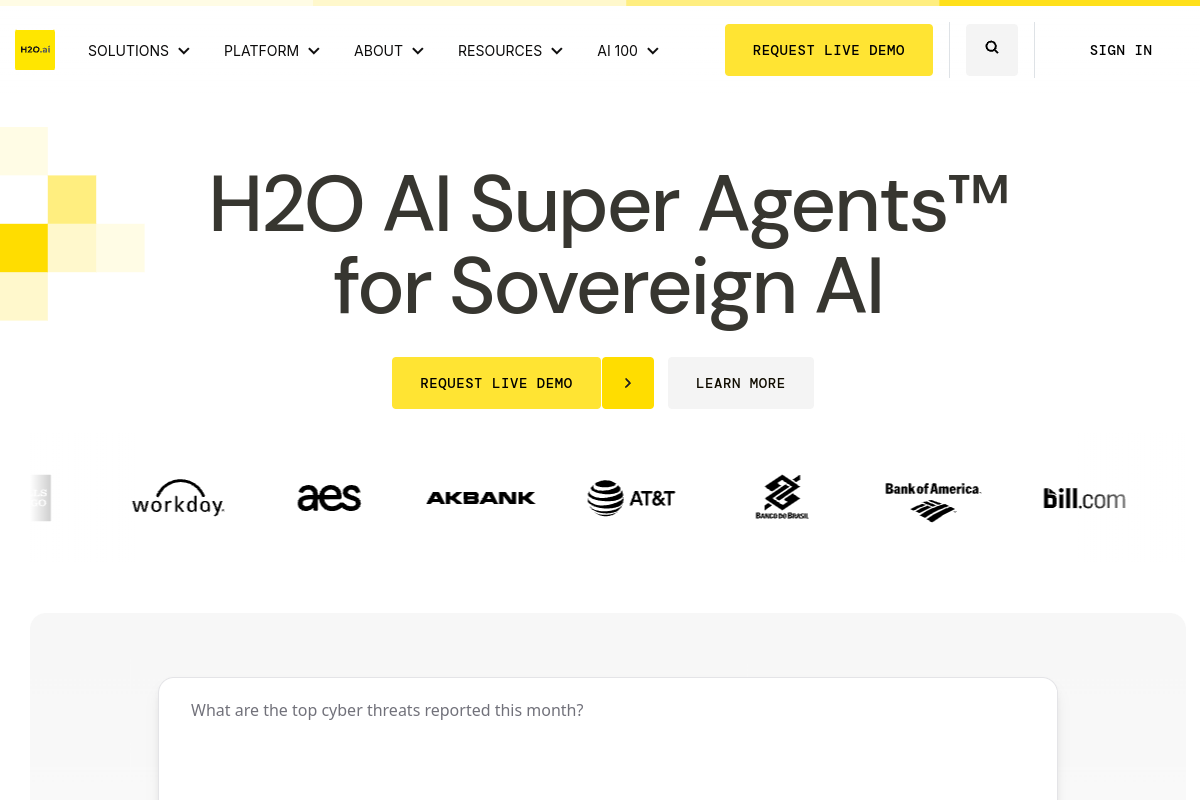
H2O.ai is a leading enterprise AI cloud platform designed to democratize AI for businesses of all sizes. It empowers organizations to build, deploy, and manage both generative and predictive AI applications effectively.
Executive Summary
H2O.ai delivers a robust enterprise AI cloud platform, offering a powerful blend of open-source machine learning and advanced generative AI capabilities. It empowers businesses to accelerate their AI journey, from automated model development with H2O Driverless AI to secure deployment and monitoring, helping to solve complex business problems and democratize AI for all.
Quick Facts
Ease of Use
7/10
Level
Medium
Beginner Friendly
Yes
Time to Master
Weeks to Months (for full suite)
What is H2O.ai?
H2O.ai is a comprehensive enterprise AI cloud platform that provides tools and services for developing, deploying, and managing machine learning and generative AI solutions. It aims to make AI accessible to a broad audience, from data scientists to business users, by simplifying complex AI workflows.
The platform offers a suite of products, including open-source machine learning frameworks and advanced automated AI capabilities, to address diverse business challenges across various industries.
Key Features
- H2O-3 Open-Source ML Platform: A distributed, in-memory machine learning platform accessible via Python, R, Java, Scala, and a web UI for building and deploying ML models.
- H2O Driverless AI: An automated machine learning (AutoML) platform that accelerates model development with automatic feature engineering, model tuning, and explainability.
- H2O LLM Studio: A no-code platform for training and fine-tuning custom enterprise-ready Large Language Models (LLMs) and Small Language Models (SLMs).
- h2oGPTe: An enterprise Generative AI solution offering multi-model support, cost controls, and integrations for creating powerful AI agents and digital assistants.
- H2O MLOps: Provides capabilities for managing the full machine learning lifecycle, from training to monitoring and deployment in production environments.
- H2O Wave: A low-code framework that enables developers to build custom AI applications using Python.
Pricing Breakdown
| Plan | Price | Features | Verdict |
|---|---|---|---|
| H2O-3 (Open-Source) | Free | Distributed in-memory ML platform, various ML algorithms, R/Python/Java/Scala APIs, Flow UI. | Best for data scientists and developers looking for a powerful, flexible open-source ML framework. |
| H2O AI Cloud (Enterprise) | Custom (High-tier enterprise pricing) | End-to-end platform for generative and predictive AI, including h2oGPTe, LLM Studio, Driverless AI, MLOps, dedicated support, and scalable infrastructure. Includes 90-day free trial. | Ideal for enterprises requiring comprehensive AI solutions, advanced automation, dedicated support, and robust governance. |
| H2O AI Enterprise Per GPU Pricing | $170,000 – $225,000/Unit (per GPU, 12-month contract) | Pricing model for H2O AI Enterprise based on GPU usage, with tiers for 1-64 GPUs, 65-128 GPUs, and 129+ GPUs. | Suitable for large enterprises with significant GPU-accelerated AI workloads. |
| H2O AI Enterprise Starter 8 GPUs with Professional Services | $720,000 (12-month contract) | Includes 8 GPUs and professional services for initial setup and support, tailored for larger deployments. | A comprehensive starting package for enterprises initiating large-scale AI projects with dedicated resources. |
Pros
- Comprehensive AI Ecosystem: Offers an end-to-end platform covering predictive and generative AI, from model building to deployment and monitoring.
- Automated Machine Learning (AutoML): Significantly speeds up model development and hyperparameter tuning, making AI more accessible.
- Open-Source Foundation: Provides H2O-3, a widely adopted open-source ML platform, fostering a strong community.
- Strong Enterprise Focus: Designed for scalability, security, and integration into enterprise environments, supporting diverse use cases.
- Explainable AI (XAI): Features like Driverless AI include capabilities for model interpretability, crucial for regulated industries.
Cons
- Steep Learning Curve for Advanced Use: While accessible, mastering the full suite for complex, custom scenarios can be challenging.
- Enterprise-Level Pricing: Advanced features and enterprise support come with a significant cost, which may not be suitable for smaller teams or individuals beyond the open-source offerings.
- Potential for Vendor Lock-in: Extensive use of the H2O AI Cloud might create dependencies on the platform’s ecosystem.
Expert Verdict
H2O.ai stands as a formidable player in the enterprise AI landscape, uniquely blending open-source accessibility with robust commercial offerings. Its strength lies in democratizing advanced machine learning and generative AI, enabling organizations to rapidly develop and deploy complex models. While the learning curve for mastering its full capabilities can be considerable for newcomers, the platform’s comprehensive features, especially its AutoML and MLOps, make it an indispensable tool for data science teams and businesses committed to an AI-first strategy. The focus on transparent and responsible AI also addresses critical enterprise concerns.
Real User Sentiment
Editor's Note
Users generally express high satisfaction with H2O.ai, particularly appreciating its AutoML capabilities for accelerating model development and its strong performance in predictive analytics. Enterprise users value its ability to handle big data and its support for regulated industries. Some advanced data scientists note that while powerful, bespoke Python/R coding offers more granular control for highly specific, experimental solutions, but acknowledge H2O.ai’s efficiency.
Source: Aggregated from discussions on TrustRadius, Gartner Peer Insights, and data science community forums like Reddit.
Common Feedback:
- “H2O.ai’s AutoML saves our team immense time, allowing us to deliver better models faster and focus on business value.”
- “The platform is incredibly powerful for deploying secure Generative AI assistants in an air-gapped environment, truly transforming operations.”
Best Use Cases
- Fraud Detection: Using H2O.ai to build predictive models that identify and reduce fraudulent activities in financial services.
- Customer Churn Prediction: Leveraging AI to forecast customer churn risk and implement targeted retention strategies.
- Personalized Marketing: Creating granular customer segments and optimizing offers and content for increased conversion rates.
- Supply Chain Optimization: Utilizing AI models for demand forecasting, inventory management, and logistics optimization.
- Healthcare Predictive Analytics: Developing models for patient outcome prediction, disease diagnosis, and treatment optimization.
Best Examples & Prompts
Recommended Workflows & Usage Scenarios:
Load structured data into H2O.ai platform, perform automated data cleaning and imputation, then execute feature engineering.
Select target variable, configure Driverless AI to run multiple algorithms, evaluate model leaderboard, and select the best performing model.
Import a domain-specific dataset into H2O LLM Studio, select a base SLM, fine-tune for specific tasks like document summarization, and deploy as an API endpoint.
Limitations You Should Know
- Requires significant computational resources for large-scale enterprise deployments and complex models.
- While offering no-code/low-code options, fully customizing advanced solutions might still require programming expertise.
- The cost of enterprise licenses can be prohibitive for smaller organizations without substantial AI budgets.
Who is using it?
- Data Scientists: For accelerating model development, experimentation, and leveraging advanced algorithms through H2O.ai’s platforms.
- Enterprise Developers: For deploying, monitoring, and integrating AI models into existing applications and building custom AI apps.
- Business Analysts: For extracting insights and solving business problems with AI, even without deep machine learning expertise, through automated tools like Driverless AI.
- Organizations in Regulated Industries: For ensuring transparent, explainable, and responsible AI deployments.
Who should NOT use it?
- Individual hobbyists or small startups with very limited budgets for commercial AI platforms, though they can utilize the open-source H2O-3.
- Data scientists who prefer absolute granular control over every line of code and parameter for highly experimental research, rather than platform automation.
- Organizations looking for a completely free, fully managed cloud AI service without any infrastructure or maintenance considerations.
Frequently Asked Questions
What is H2O.ai used for by data scientists?
What are the pricing plans for H2O.ai?
How can I use H2O.ai Driverless AI?
Does H2O.ai offer open-source tools?
What business benefits can H2O.ai provide?
Free Alternatives & Details
If you’re exploring H2O.ai but want to know if there’s a completely free version or better options available, you’re not alone. While H2O.ai offers great features, many users look for a 100% free H2O.ai alternative before committing to a paid plan. In 2026, the AI landscape has exploded with open-source tools and generous free tiers. Before you pay for a premium subscription, make sure to check out our complete directory of free AI tools to compare the best free alternatives currently on the market.