OpenML
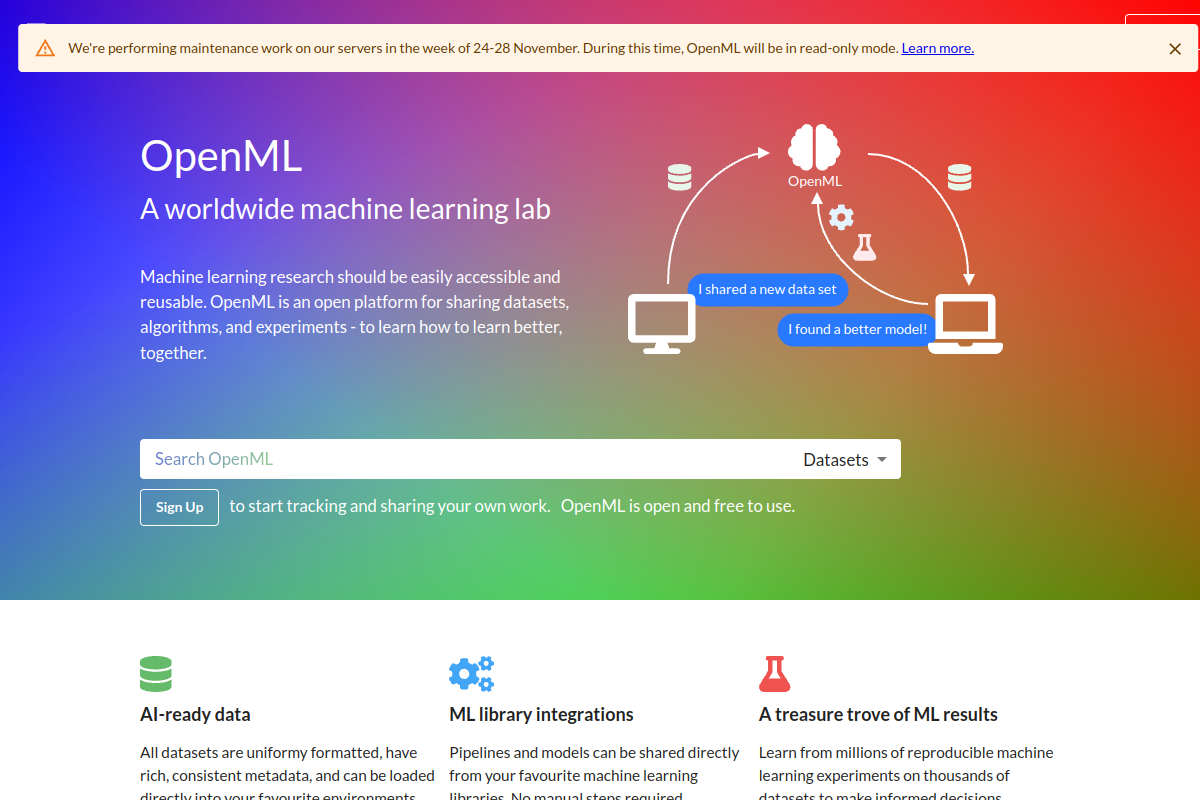
OpenML is an open platform designed for collaborative machine learning, facilitating the sharing of datasets, algorithms, and experiments. It aims to make machine learning research more accessible, reusable, and transparent globally.
Executive Summary
OpenML serves as an invaluable, free, and open platform for collaborative machine learning, making it easier to share datasets, algorithms, and experiments. It significantly contributes to advancing reproducible AI research by providing a centralized, accessible ecosystem.
Quick Facts
Ease of Use
7/10
Level
Medium
Beginner Friendly
Yes
Time to Master
Weeks to explore fully, hours for basic API use
What is OpenML?
OpenML is an open science online platform designed to facilitate collaborative machine learning by enabling the sharing of datasets, algorithms, and experiments. It aims to make machine learning research more accessible, reusable, and transparent for the global community.
This platform provides a structured environment where users can upload and access a vast repository of AI-ready data, alongside various machine learning algorithms and reproducible experiment results, fostering a ‘worldwide machine learning lab’.
Key Features
- Open Data Sharing: OpenML provides uniformly formatted, AI-ready datasets with rich metadata, making them easily discoverable and usable across different ML environments.
- Algorithm & Flow Repository: Users can share and discover machine learning algorithms (‘flows’) and pipelines, integrating directly from popular ML libraries like scikit-learn and mlr.
- Reproducible ML Experiments: The platform automatically records dataset versions, pipeline structures, architectures, and hyperparameters, ensuring experiments are fully reproducible.
- API Integrations: OpenML offers robust APIs for Python and R, allowing seamless integration into existing workflows for uploading and downloading data and results.
- Benchmarking Suites: Curated suites of machine learning tasks are available to standardize and improve benchmarking efforts across various algorithms.
Pricing Breakdown
| Plan | Price | Features | Verdict |
|---|---|---|---|
| OpenML Platform | Free | Access to all datasets, algorithms, tasks, and experiment results; API access for Python and R; ability to upload and share work; participation in the open science community. | Best for researchers, data scientists, and students seeking a collaborative, open-source platform for machine learning research and sharing. |
Pros
- Fosters Open Science: Promotes transparency and collaboration in machine learning research.
- Ensures Reproducibility: Automatically tracks experiment details, datasets, and algorithms for verifiable results.
- Extensive Resource Library: Offers a large collection of datasets, tasks, flows, and experimental runs.
- API-Driven Workflow: Allows seamless integration with popular ML tools and environments (Python, R, WEKA).
- Free to Use: Provides all its core functionalities without any cost.
Cons
- Niche Audience: Primarily caters to researchers and ML practitioners, less so for absolute beginners.
- Not a Training Platform: Lacks integrated cloud-based model training or deployment infrastructure.
- Potential Overfitting Concerns: Historical discussions exist around managing overfitting given public access to data and evaluation results, a challenge in open benchmarking.
Expert Verdict
OpenML stands out as a critical infrastructure for open science in machine learning. Its focus on reproducibility, collaborative sharing of data and algorithms, and integration with standard ML tools addresses fundamental challenges in AI research. While its primary audience is academic and research-oriented, its principles benefit anyone looking to build on transparent, verifiable machine learning work.
Real User Sentiment
Editor's Note
The general sentiment for OpenML is highly positive, especially within the academic and research communities, due to its commitment to open science, reproducibility, and collaborative features. It is widely regarded as a valuable resource for advancing machine learning research.
Source: Aggregated from discussions within academic forums, research papers citing OpenML, and GitHub community engagement.
Common Feedback:
- “‘OpenML has been instrumental in making our research verifiable and comparable with others. The ability to easily access and contribute standardized datasets is a game-changer.'”
- “‘As a student, OpenML provides an incredible sandbox to explore a vast array of ML experiments and understand how different algorithms perform on real-world data.'”
Best Use Cases
- Data Exploration: Discovering relevant datasets for a new research project by filtering through OpenML’s extensive catalog based on task type and data characteristics.
- Algorithm Benchmarking: Comparing the performance of a custom machine learning algorithm against existing models on a standardized OpenML task using its API for automated evaluation.
- Reproducible Research: Uploading a complete machine learning experiment, including dataset, preprocessing steps, model, and hyperparameters, to ensure full reproducibility by other researchers.
Best Examples & Prompts
Recommended Workflows & Usage Scenarios:
Accessing a Dataset: Use the OpenML Python API to fetch a specific dataset by ID and load it into a pandas DataFrame for analysis.
Running a Model on a Task: Integrate a scikit-learn classifier with OpenML’s API to run it on a predefined task and publish the results.
Comparing Model Performance: Utilize OpenML’s features to compare the evaluation metrics of multiple ‘flows’ (algorithms) on a particular dataset or task.
Limitations You Should Know
- The platform is not designed as a primary cloud-based environment for intensive model training or large-scale MLOps deployments.
- While it promotes open data, the challenge of potential overfitting in public benchmarking scenarios is an ongoing community discussion.
- Requires some foundational understanding of machine learning concepts and programming (Python/R) to leverage fully.
Who is using it?
- Machine Learning Researchers: For sharing, discovering, and building upon datasets, algorithms, and experiments transparently.
- Data Scientists: For accessing diverse datasets and evaluating models against a wide range of tasks and existing solutions.
- Algorithm Developers: For testing and publicizing new statistical methods or machine learning algorithms on a variety of datasets.
- Students & Educators: For learning, participating in challenges, and accessing a broad spectrum of ML resources and experimental results.
- Domain Scientists: For uploading their data to leverage the global ML community’s expertise in analysis.
Who should NOT use it?
- Absolute beginners without any prior machine learning or programming experience, as it’s not a ‘no-code’ solution.
- Organizations primarily seeking proprietary, closed-source machine learning development and deployment platforms.
- Users needing a fully managed, high-performance cloud infrastructure for training cutting-edge deep learning models at scale, beyond dataset/experiment sharing.
Frequently Asked Questions
What is OpenML used for in machine learning research?
How can I share my datasets and experiments on OpenML?
Is OpenML a free platform for machine learning collaboration?
What are the benefits of using OpenML for reproducible AI?
Does OpenML integrate with popular machine learning libraries?
How does OpenML ensure the reproducibility of machine learning experiments?
What is an 'OpenML Flow' and how does it relate to algorithms?
Free Alternatives & Details
If you’re exploring OpenML but want to know if there’s a completely free version or better options available, you’re not alone. While OpenML offers great features, many users look for a 100% free OpenML alternative before committing to a paid plan. In 2026, the AI landscape has exploded with open-source tools and generous free tiers. Before you pay for a premium subscription, make sure to check out our complete directory of free AI tools to compare the best free alternatives currently on the market.